The Gift of the Groan Zone: Finding Opportunity in the Messy Middle
A team being stuck is not a sign of failure — it’s where innovation and understanding are born. Learn how to hold space for the messy middle and turn conflict into collaboration.

By David LeBlanc
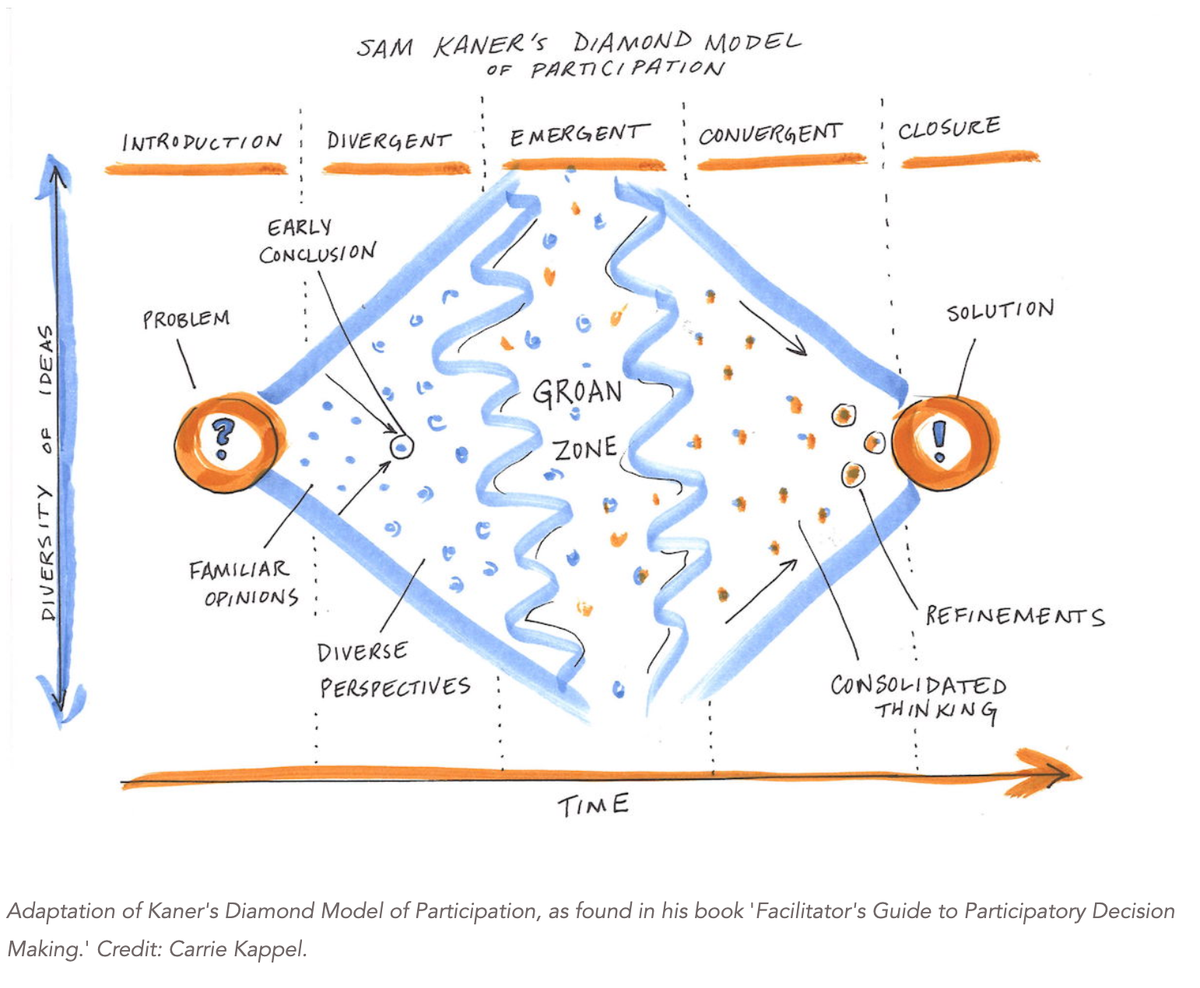
Image: Adaptation of Sam Kaner’s Diamond Model of Participation, illustrated by Carrie Kappel.
As a Team Coach, I get the opportunity to work with some amazing and accomplished teams. And over the past few weeks, I’ve spend some time with some of those teams who find themselves stuck — struggling with conflict, inefficiency, and a creeping sense of frustration. In many cases, their instinct has been to move faster, to focus on tasks, and to control what they can. The energy becomes tight, micro-managed, and urgent. But beneath that urgency lies something much deeper: discomfort with uncertainty.
And that discomfort is exactly where the opportunity lies. As I spent time with the teams, I shared Sam Kaner's Diamond Model of Participation, which I first discovered doing my Masters at Royal Roads University in 2011
The Diamond of Participation
Sam Kaner’s Diamond Model of Participation illustrates how groups move through stages of conversation and collaboration — from familiar opinions and divergent perspectives to consolidated thinking and shared solutions.
At the center of this process is what Kaner calls The Groan Zone — a messy, unpredictable space where teams are wrestling with differing perspectives, competing needs, and emerging insights. It’s the space between divergence and convergence, where alignment hasn’t yet been reached, and emotions can run high.
Most teams hate being here.
But this is the place where innovation and understanding are born.
Why We Rush Through the Groan Zone
When teams experience conflict or confusion, there’s a natural impulse to move quickly to resolution — to skip the discomfort and find a neat solution. Yet, when we rush through the Groan Zone, we risk missing the deeper wisdom that diverse perspectives offer.
This avoidance often shows up as:
- Task fixation: staying busy instead of staying curious.
- Micro-management: tightening control when things feel uncertain.
- Premature consensus: agreeing too soon to avoid tension.
The irony is that in trying to avoid conflict, teams often create more of it. The unsurfaced perspectives, unspoken frustrations, and unseen assumptions eventually reappear — sometimes louder than before.
The Groan Zone as a Space of Possibility
What if we reframed this zone not as a failure of teamwork, but as a necessary phase of collective sense-making?
The Groan Zone is not the problem. It’s the process.
It’s where new ideas collide, where assumptions are tested, and where genuine collaboration takes root.
When teams can stay with the discomfort — long enough to really listen — something remarkable happens. They begin to see connections they hadn’t noticed before. They start to hear the intent beneath others’ words. They find a way to move forward together, even if not everyone gets exactly what they want.
That’s alignment.
Not identical thinking, but shared purpose.
How to Lead Through the Groan Zone
Leaders play a critical role in holding this space. Here are a few guiding practices:
- Name the discomfort.
Normalize that this phase feels chaotic — it’s supposed to.
Naming it helps reduce the anxiety that something is “wrong.” - Invite all voices.
Make sure each perspective is heard before synthesis begins.
Silence is not agreement; it’s often withdrawal. - Slow down to speed up.
Taking time here prevents rework later.
True alignment always pays dividends downstream. - Hold curiosity over control.
Shift from “How do I fix this?” to “What are we learning here?” - Trust the process.
The Groan Zone doesn’t last forever. But rushing through it ensures you’ll return to it again. - From Groan to Grow
In the end, the Groan Zone isn’t about conflict — it’s about creation.
It’s a crucible for innovation, understanding, and shared ownership.
So the next time your team finds itself there — in that uneasy, confusing middle — pause. Take a breath. Make space.
The very thing you’re trying to escape might be the space where your best ideas — and your strongest relationships — are waiting to emerge.
And let's be honest - creating space individually and as a team is challenging. We have so many demands on our time. That space is critical for our success. Here are a couple recent resources on this concept of creating "Space to Lead":
 David LeBlanc

Reflection for Your Team
- When was the last time your team experienced its own Groan Zone?
- How did you respond — with curiosity or control?
- What might it look like to make more space for the messy middle?