Where Progress Gets Stuck Between Teams
Capable people can work hard while shared progress stalls. Collaborative coaching helps teams examine what happens between them: unclear decisions, difficult handoffs and unspoken assumptions. Discover how changing everyday patterns can strengthen accountability and help shared work move forward.

Imagine a project meeting where every team has a reasonable explanation.
One group is waiting for approval. Another is protecting a deadline. A third needs information it requested last week. Each has completed the tasks within its control. Yet a decision that matters to all of them remains unresolved.
The meeting ends with an agreement to follow up. Everyone returns to work carrying a slightly different understanding of what happens next.
There may be considerable competence around that table. People may share information freely and help each other when asked. But how much responsibility do they take for what happens beyond their own part of the work?
That question sits at the heart of collaborative maturity. It also helps explain why capable, committed people can struggle to turn their combined effort into shared progress.
Recognizing how we actually work together
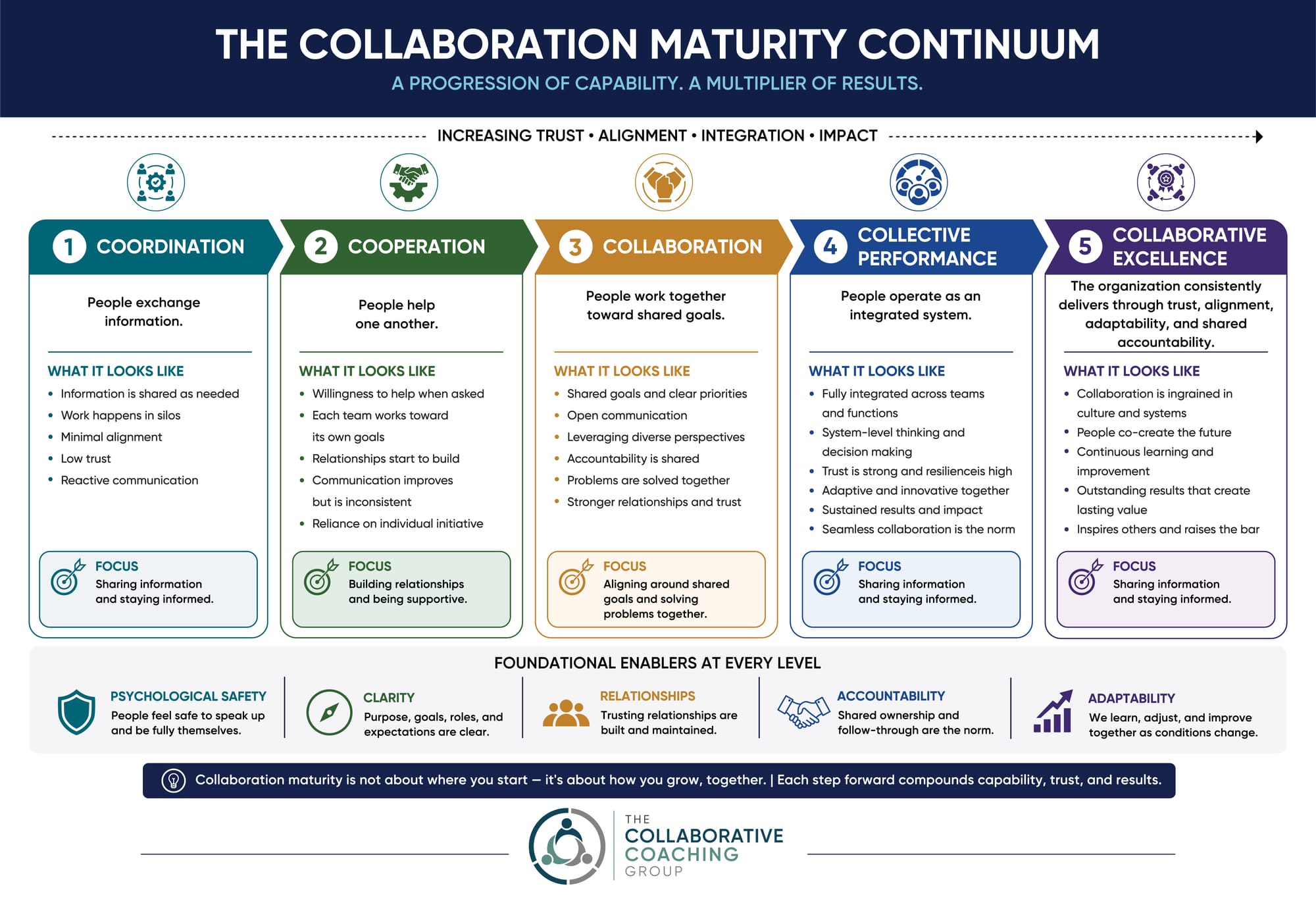
At The Collaborative Coaching Group, our Collaboration Maturity Continuum describes five levels: Coordination, Cooperation, Collaboration, Collective Performance and Collaborative Excellence. It gives teams a way to examine how they work together and what they need to develop.
The distinctions matter because sharing information, offering help and taking shared responsibility ask different things of people. A team can have friendly relationships and frequent communication while still leaving its most important interdependencies unmanaged.
Consider how the same project meeting could look across the continuum.
Coordination
At Coordination, people exchange information. Each team provides its update, identifies what it needs and returns to its own responsibilities. The emphasis is on staying informed.
This is useful work. However, everyone can leave knowing more about the delay without anyone having responsibility for resolving it across team boundaries. The conversation describes the pieces, while the connection between them remains uncertain.
Cooperation
At Cooperation, people help one another. Someone offers to chase an approval or share a resource. Relationships begin to make the work easier, although each team continues to pursue its own goals.
The vulnerability is reliance on individual initiative. Progress may depend on who knows whom, who has time to help or who is willing to work around a difficult process. Helpful people can become indispensable while the underlying difficulty remains.
Collaboration
At Collaboration, people work together toward shared goals. The group examines what the project needs and resolves the competing priorities affecting it.
In our meeting, this could mean agreeing on the decision required, making the tradeoffs explicit and clarifying who will do what. People can question a proposed solution, bring different perspectives and share accountability for what they agree. Their discussion begins to change how the work moves forward.
Collective Performance
At Collective Performance, people operate as an integrated system. Teams consider how decisions affect the whole project, including the demands they create elsewhere.
Rather than repeatedly negotiating the same difficult handoff, the groups involved develop a dependable way to manage it. They anticipate dependencies, respond together when conditions change and use their understanding of the wider system to guide decisions. Shared performance becomes less dependent on repeated acts of rescue.
Collaborative Excellence
At Collaborative Excellence, the organization consistently delivers through trust, alignment, adaptability and shared accountability. Collaboration is embedded in its culture and systems, with ongoing learning and improvement supporting lasting value.
The work extends beyond one successful meeting or one well-connected project team. Learning influences how future work is designed, how leaders behave and how organizational systems support people in working together.
Using the continuum to develop capability
The practical value of the model comes from examining specific work. A team might ask: When a priority changes, do we simply inform one another? Do we offer help? Or do we reconsider the implications together and agree on a response?
The answer may vary across relationships and situations. Teams can use that variation to identify where stronger collaboration would make a difference, rather than assigning themselves a single flattering label.
The continuum identifies psychological safety, clarity, relationships, accountability and adaptability as foundational enablers at every level. A group cannot assume these conditions are established because it has agreed on a shared goal. They need attention in the decisions and conversations that follow.
People need to be able to raise a concern without being dismissed. They need clarity about authority and expectations. They need relationships that can withstand disagreement, commitments they can rely on and the ability to adjust together.
How collaborative coaching supports the shift
Collaborative coaching helps people examine these conditions within the work itself. Coaches can be embedded alongside a project or team, observing interactions, supporting reflection and helping people test changes in how they work together.
In the meeting described earlier, a coach might notice that everyone refers to "approval" without naming who can give it. Or that two teams use the word "ready" to mean different things. Or that an important concern is discussed privately but never raised at the table.
These observations create an opportunity to examine the pattern. What are we each assuming? What makes this difficult to discuss? How are our own responses contributing? What agreement would allow us to act?
That inquiry needs to lead to practical changes. The group might clarify decision authority, agree on what a complete handoff requires or change how it responds when someone raises a risk. The people responsible for delivery retain ownership of those decisions.
There are also issues that require direct operational action. A capacity gap needs a resourcing decision. A missed commitment needs to be addressed. Coaching can help people confront those realities and work through their implications together.
Looking for progress in everyday work
Movement along the continuum should become visible in how work gets done. Are decisions staying resolved? Are teams considering consequences beyond their own deliverables? Are risks being raised while there is time to respond? Are agreed changes reducing rework or improving reliability?
These signs can be considered alongside project outcomes. Many factors affect results, so improvements should not automatically be attributed to coaching. What matters is whether people are developing a more dependable capacity to work together and whether that capacity is helping delivery.
At your next team meeting, choose one recurring difficulty and ask: Where on the continuum does our current response sit? What would the next level look like in this situation? What condition needs attention, and what will we try?
Return to those questions after the group has tested its change. Examine what happened and adjust. That is how a maturity model becomes useful: people use it to make a different choice in the work they share.